Cargèse 2026 School on Subduction Zone Processes
Cargèse, Corsica (France)
19-25 Oct 2026

Cargèse 2026 School on Subduction Zone Processes
Cargèse, Corsica (France)
19-25 Oct 2026
The Cargèse 2026 school will be held from October 19 to 25, 2026 at the IESC in Corsica and will focus on subduction zones. A 2-day field trip in Alpine Corsica will take place during the final weekend of the school (October 24–25, 2026).
Subduction zones are convergent plate boundaries, where oceanic plates sink into the mantle. They host the largest earthquakes, but also slow slip and tremors. The dynamics of subduction zones, their ability to host episodic tremor and slip, their segmentation depend on several parameters, such as the age and structure of the incoming plate, the geotherm, the presence of fluids, or the thickness and geology of the overriding plate. The factors controlling the time of occurrence and size of the earthquakes, the nature of the link between the slow slip events and the seismic rupture, the role of fluids, the structure and geology of the subduction channel, the rheology of the mantle and its impact on the short-term dynamics of the subduction zones are active areas of research and require multidisciplinary approaches, encompassing several communities that should interact more.
The objective of this school is to provide students and young researchers with an overview of the state of the art and current challenges in the study of active subduction. We aim at gathering specialists of different fields, including geodynamic modelers, geologists, seismologists, geodesists, geophysicists to build bridges between these different disciplines and come up with a broad overview of the processes at stake in subduction zones. We also aim at discussing their potential interaction-retroaction effects.
Confirmed Speakers: Kelin Wang - Geological Survey of Canada, Emily Brodsky - UC Santa Cruz, USA, Matias Carvajal - Pontificia Universidad Católica de Valparaíso, Chile, Fanny Garel - Université de Montpellier, France, Claire Currie - University of Alberta, Canada, Armel Menant - Université Côte d'Azur, France, Harsha Bath - CNRS, Ecole Normale Supérieure, Paris, France, Melodie French - Rice University, USA, William Frank - Massachusetts Institute of Technology, Boston, USA, Satoshi Ide - University of Tokyo, Japan, Mathilde Radiguet - Université Grenoble Alpes, France, Claudio Faccenna - GFZ, Germany, Jean Paul Ampuero - IRD, France, Philippe Agard - Sorbonne Université, Paris, France, Anne Socquet - Université Grenoble Alpes, France, Andres Tassara - Universidad de Concepcion, Chile, Théa Ragon - CNRS, Grenoble, France
* Please note: Pre-registration counts only after Step 1 (the pre-registration form) and Step 2 (the abstract submission) are completed. Submitting the form alone isn’t enough. Abstract submission does not guarantee acceptance; notifications of acceptance will be sent early June.
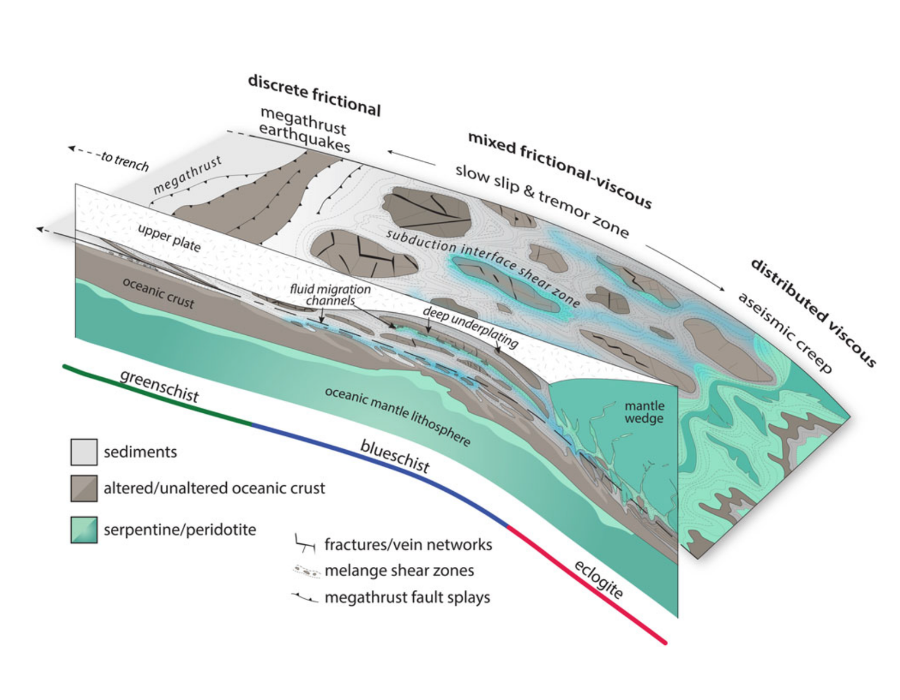
© Whitney M. Behr & Roland Bürgmann (2021), What’s down there?, Philosophical Transactions of the Royal Society
This thematic school is organized in coordination with different research networks that structure the community actively working on the active dynamics of subduction zones :
- in France FRENSZ
- in the United States SZ4D
- in Japan Science of slow to fast earthquake
- in Germany IPOC
- in Chile AndesNet
 Loading...